Lot #003
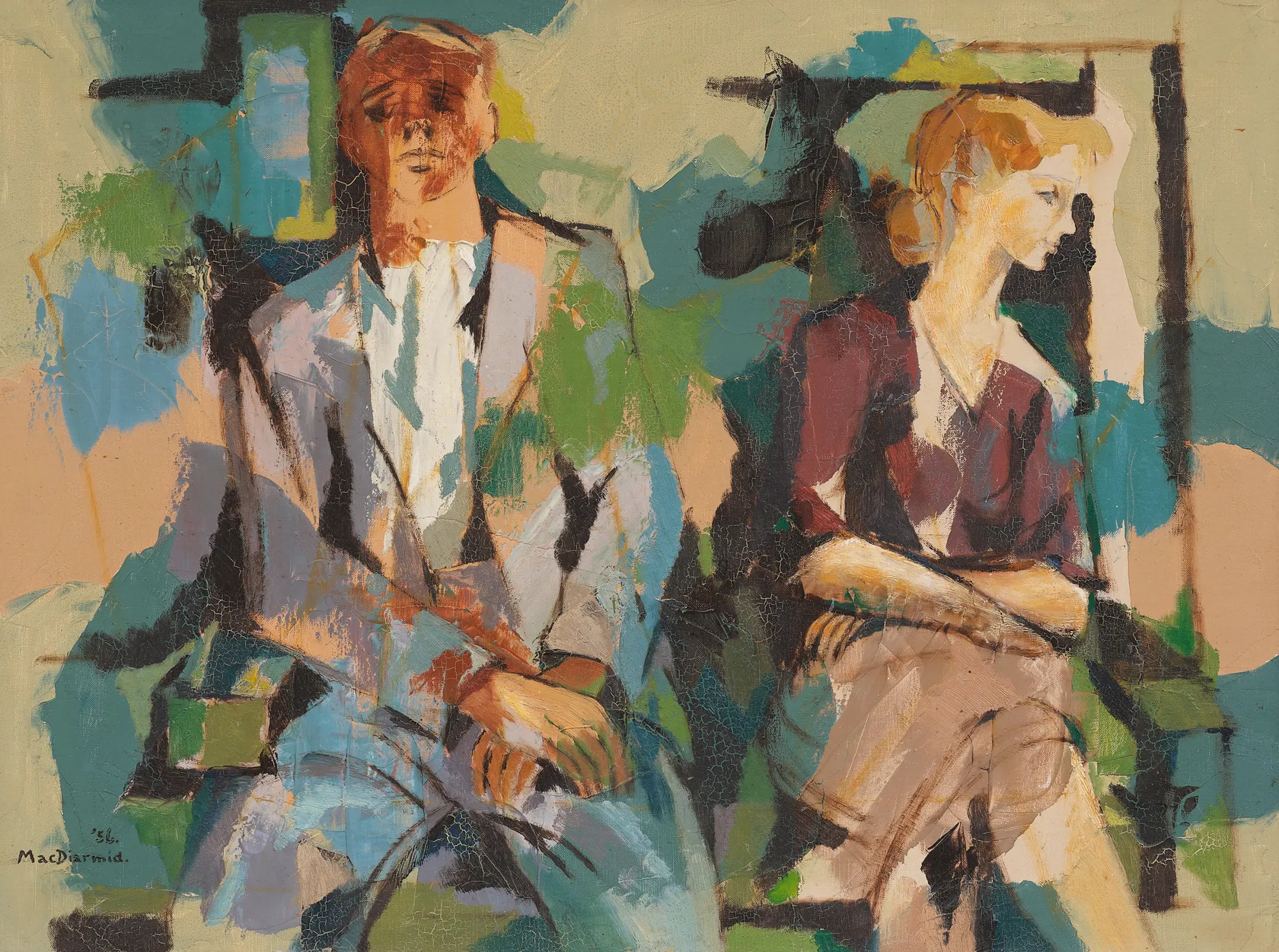
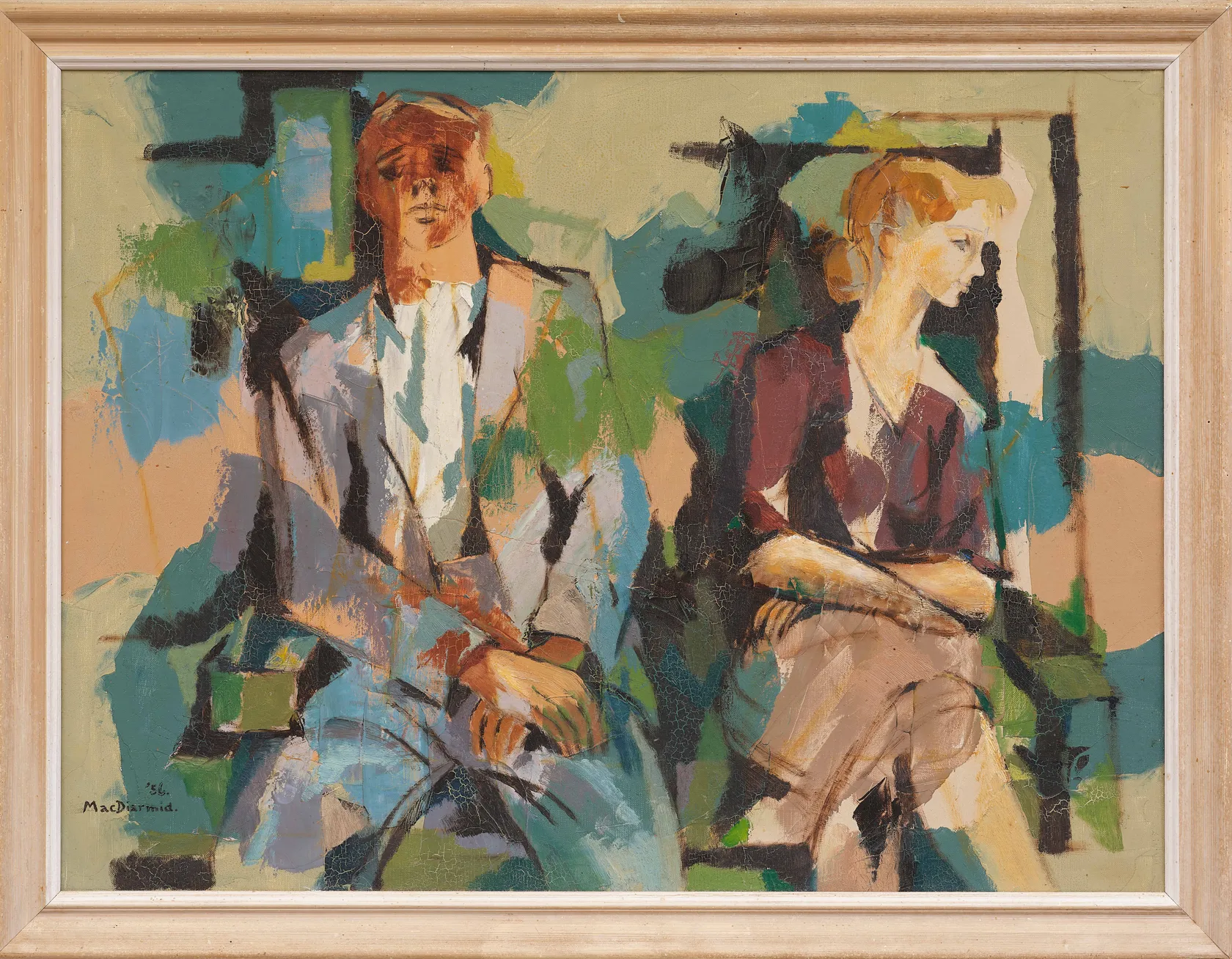
The Passengers, 1956
Oil on board
44.5 x 59.5 cm
Estimate NZ$7,000 – NZ$10,000
Signed & dated 1956 lower left
To request a condition report, please contact us at auctions@artcntr.co.nz or phone +64 9 379 4010
Auction Details
Literature
Two people travelling on a train, rather than by plane, given that flying was an expensive option at the time. There is a sense that this woman and man know one another but are trying not to. Their body language suggests a certain estrangement – her head fully turned, gazing out the window, her leg crossed away from him; his knitted brow and slumped shoulders.
Douglas was always intrigued by the nuances of non-verbal communication, what he calls the ‘human condition’. As a painter, he perfected the art of closely observing without actually appearing to look, always with a sketchbook ready in his pocket. “Years of curiosity have given my peripheral vision unusual powers. I can see a great deal out of the corners of my eyes and always have. People are fascinating. Yet I realise that if you stare, it’s unpleasant and uncomfortable for them. Highly impolite, so I don’t make this mistake but I manage to take in a great deal from one side or the other.”
During the mid-1950s to 1960s, he regularly painted French people going about their everyday lives. This was MacDiarmid rediscovering his adopted country and providing a fascinating figurative glimpse of the interplay between traditional and modern European culture. Among paintings of folk engaged in typical tasks were other figures simply being, captured for a look or an attitude that piqued his interest. A number of these paintings found their way into private and public collections in New Zealand.
Apart from road trips to the Loire Valley, Provence and the French Riviera, Douglas was mostly based in Paris in 1956. He was busy with commissioned portraits, regularly selling landscapes through a gallery on Montmartre hill, and thanking his lucky stars for an extraordinary change of fortune. After years of hand-to-mouth existence, he had actually found himself living in luxury, set up with his first studio, overlooking a garden. This was at the home of a wealthy, mercurial older Parisienne Jacqueline, a talented amateur painter who was first his patron, later his lover and fiancée. It was a tumultuous relationship that often had him questioning his worth as a still penniless painter and, sadly, came to an end a few years later when she died unexpectedly after a skiing accident.
The passengers in this painting were probably observed in August 1955, en route between France and Scotland. Having gratefully accepted the priceless offer of a studio, Douglas first set off for the Edinburgh International Festival (August 21-September 10) with his composer friend and first great love Douglas Lilburn, on sabbatical from New Zealand. What is now a seven-hour fast train ride would have taken a couple of days – ample time to study his fellow passengers and make pages of notes and rapid sketches to develop later.
How did this painting come to New Zealand? During Douglas’ desperate years in the 1950s and 1960s, while struggling to find a professional foothold in the fickle French art market, he largely survived on the generosity of loyal New Zealand friends like Douglas Lilburn, his old university professor Frederick Page (husband of his first painting mentor Evelyn Page), and Dr Ian and Elspie Prior, who teamed up as MacDiarmid’s voluntary art agents, selling paintings privately within their professional and social networks to keep him afloat. He regularly sent bundles of paintings home for sale and friends brought artwork back to New Zealand in their luggage from European trips.
In a 17 February 1959 letter to Douglas, Lilburn wrote: “I’m having a high old time with red tape. The Bank of NZ told me regretfully last year they could not keep on the old system of remittances. I must get an import licence! So I filled in forms by the yard and shot them in last December. After two months back comes a blank refusal. I go down to Customs and say, Who makes this decision? – We don’t know says the nice little joker. It begins to feel like a Kafka novel. I’m furious because (Prime Minister) Nash said publicly last year that works by NZ painters could be brought in. Shall I wait on his doorstep? But I cool off and call JC Beaglehole who rings Dr Sutch in Industries and Commerce, who sends a man over to Customs, who ring me up happily at 8.30 next morning to tell me it’s all OK. Isn’t it wonderful!
“And I’ve even got a bit of money to send you too. Another watercolour to the Campions. And the Priors want to buy one of the oils. Please tell me how much you are asking for these….”
Douglas knew Richard and Edith Campion through mutual friends like Lilburn and Ngaio Marsh, both of whom Richard collaborated with on theatrical productions. They all moved in the same artistic circles while MacDiarmid was back in New Zealand during 1949-50, working in Wellington at the Alexander Turnbull Library and on 2YA as a radio actor and announcer. During that year, his work came to national attention through wide media coverage of his first two solo exhibitions.
Anna Cahill
Provenance
Collection of Edith Campion
Lot #003
The Passengers, 1956
Send Enquiry
Lot #003
The Passengers, 1956