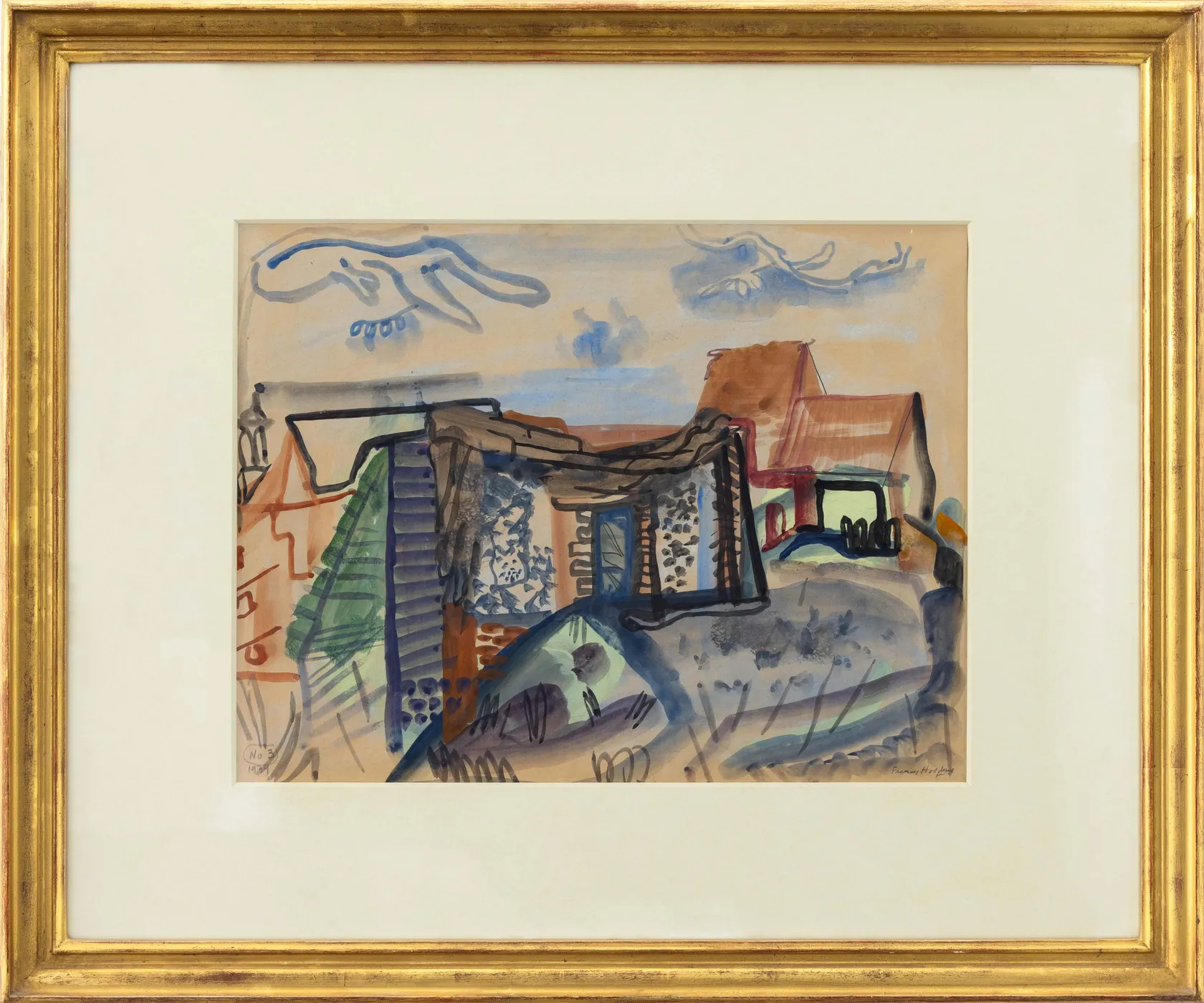
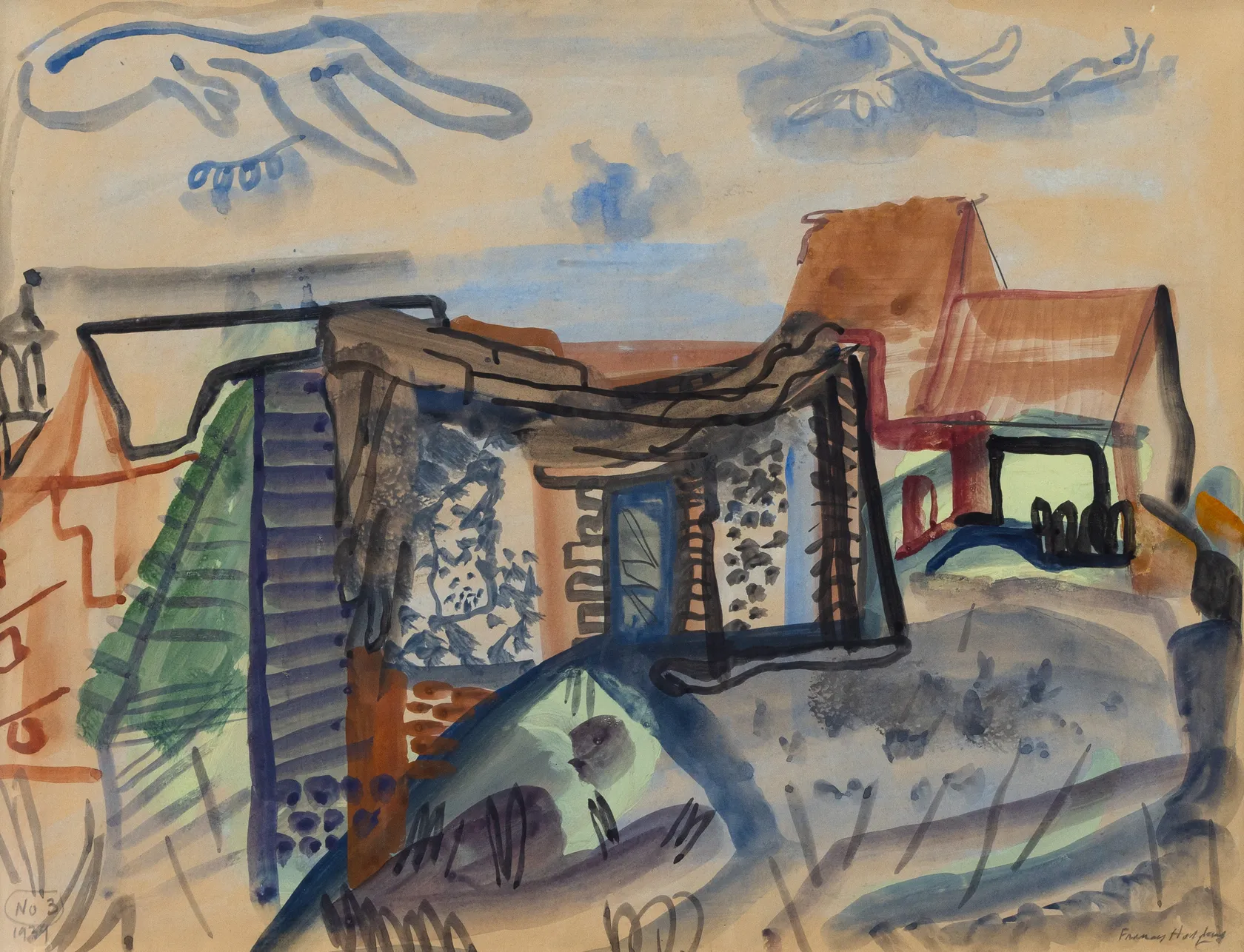
East Anglican Farm, Frances Hodgkins
This interest in architecture developed further once she moved to Europe in 1901, whether focusing on the highly detailed timber and lathe buildings in France or the block like plaster structures she found early on in Morocco, or again in Spain in the 1930s. However, it was only from the late 1920s onwards, that buildings became the actual subject of particular paintings, rather than the nuanced backdrop to people and objects.
By the end of the 1930s, Hodgkins had developed a complex style, often deconstructing buildings to focus on their individual elements. East Anglian Farm, 1939 was exhibited by that title in 1940 at St George’s Gallery, London, although at some point it also was identified as Dorset Farm. Both locations were particularly relevant to her subject matter. Dorset was where Hodgkins was mainly based from 1937 onwards, but East Anglia, or specifically Suffolk, was the home of her close friends and fellow artists Cedric Morris and Arthur Lett Haines, where she was able to enjoy delicious food (Lett was an excellent and creative cook), the pleasure of Cedric’s beautiful garden, and lively and stimulating conversation. As Hodgkins didn’t keep a diary, we have to rely on her letters to trace her whereabouts, which are helpful when she is based somewhere for some time, but not necessarily indicative of places she merely visited for a week or two.
And with her peripatetic nature Hodgkins took every opportunity to venture out into the countryside in a constant quest for new subject matter. It was only with the arrival of WWII that she was forced to make a more permanent base in Corfe Castle, Dorset. East Anglian Farm is painted rapidly but with a remarkably steady brush. The radiant skies of high summer are suggested by a pellucid blue wash outlining anamorphic clouds that bear little resemblance to natural phenomena. Although often attracted to the discarded piles of detritus that were a feature of certain farmyards, here the buildings themselves are broken up into their respective parts, as clusters of steeply pitched roofs, and distinct means of wall construction. Horizontal boards are outlined in blue, serving as a bulwark to a pebbled wall suggestive of knapped flint, which are a common feature of traditional buildings in a number of England’s southern counties. These are balanced in turn by a section of red brick. Behind the central structure another building on the left consists simply of bold outlines in red ochre and black, bracketed on the far right by another farm structure that is more readily identified as a building. You can sense Hodgkins’ enjoyment in her mark making, each brushstroke translating what she observes into something akin to an abstracted patchwork. It is as if the compilation of walls and roofs have become untethered from their foundations and freed to move like dancers on a stage, in an interpretation full of verve and humour.
Mary Kisler