The Moutohura Waka Unua Sails with the Endeavour, November 2 1769
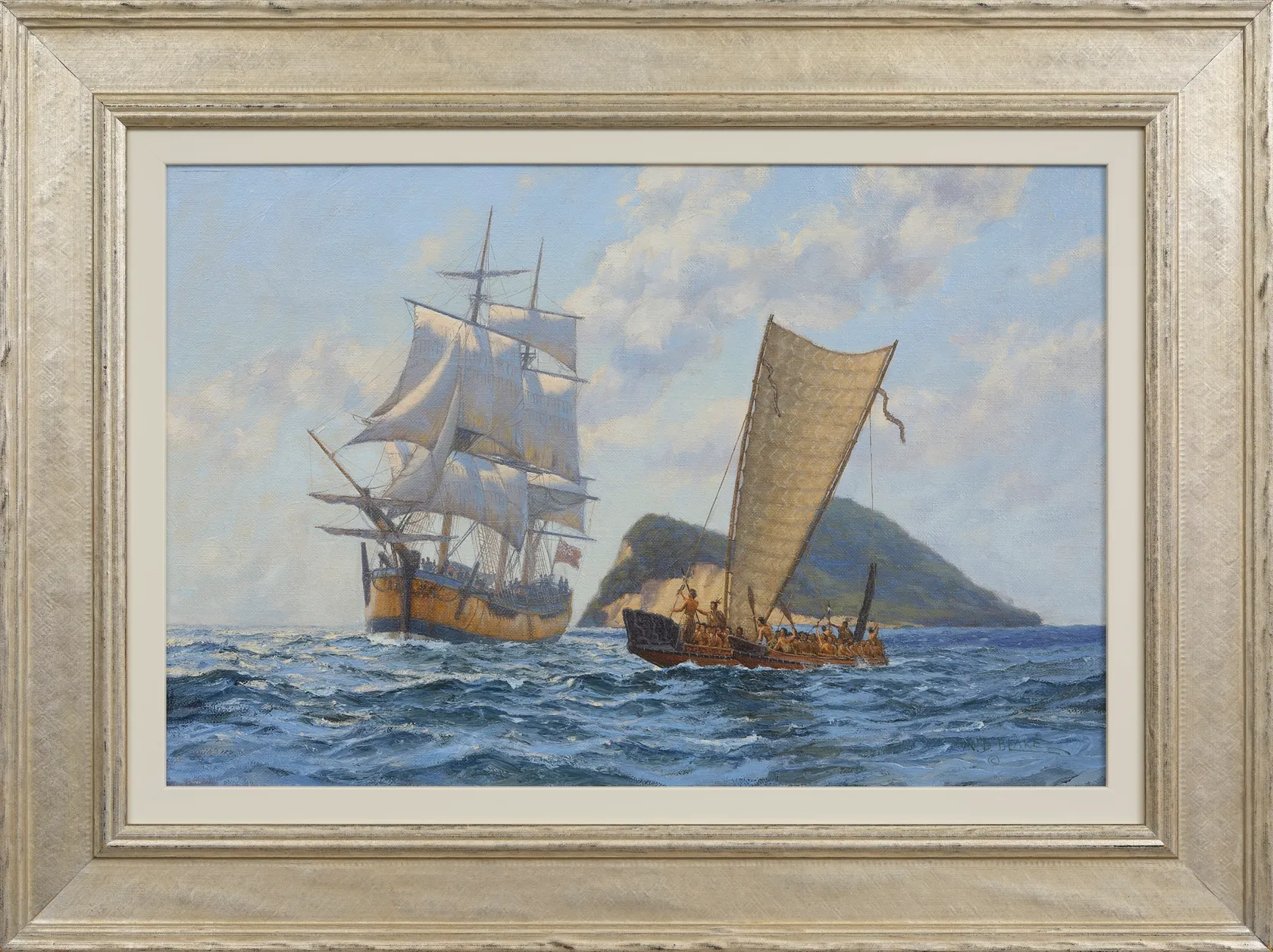
This work depicts the historical encounter between the Moutohora waka unua (double hulled canoe) and Captain James Cook's HMS Endeavour. Moutohora/Whale Island, which is approximately 6 km off the coast of Whakatane, on the East coast of the North Island, is in the background. Both vessels sailed together for over an hour with Tupia, Cook's invaluable Tahitian navigator and interpreter during his first voyage, talking with crew of the Moutohora waka unua. The painting shows the Moutohora waka unua leaving the Endeavour with its crew brandishing paddle, taiaha and patu.
On 2 November 1769, Herman Spoering, a 35-year-old draughtsman of natural history and the personal secretary to Joseph Banks, on board the Endeavour, sketched the Moutohora waka unua. The sail of the Moutohora waka unua was made of woven flax panels. A zig zag pattern was woven in each panel with sections of the zig zag weaving allowing the light to show through. This panel arrangement, with its areas of 'see-through' quality can be seen in Spoering's very accurate sketch. The Moutohora waka unua's sail seems very close in construction and detail to the sail known as Te Ra. Te Ra is the only known Maori customary sail in existence and has been in storage at the British Museum for over 200 years. A replica of Te Ra has recently been made by a group of dedicated weavers who are part of Te Ringa Rau Pa. According to estimates, the Moutohora waka unua consisted of an 18 metre long Waka Tua lashed approximately 300mm apart from a smaller canoe. The sail was lashed to two spars, which were supported by forestays and backstays. The sail was approximately 9m high. It was not triangular but had a width of approximately 1m at the base. In the painting the lengths of the two backstays are being changed by crew members in order to give a better sail shape. Crew members may be seen bailing water out of the smaller canoe. Being lower to the water than the larger waka tua some waves would splash over the gunwales. The 10-knot wind in the painting is from astern, thus enabling the Moutohora waka unua to sail, with swells, from the starboard quarter, lifting the bows.
The Moutohura Waka Unua Sails with the Endeavour, November 2 1769
Send Enquiry
The Moutohura Waka Unua Sails with the Endeavour, November 2 1769
Download Artwork Details
The Moutohura Waka Unua Sails with the Endeavour, November 2 1769
Enter your details to receive a PDF flyer for this artwork.